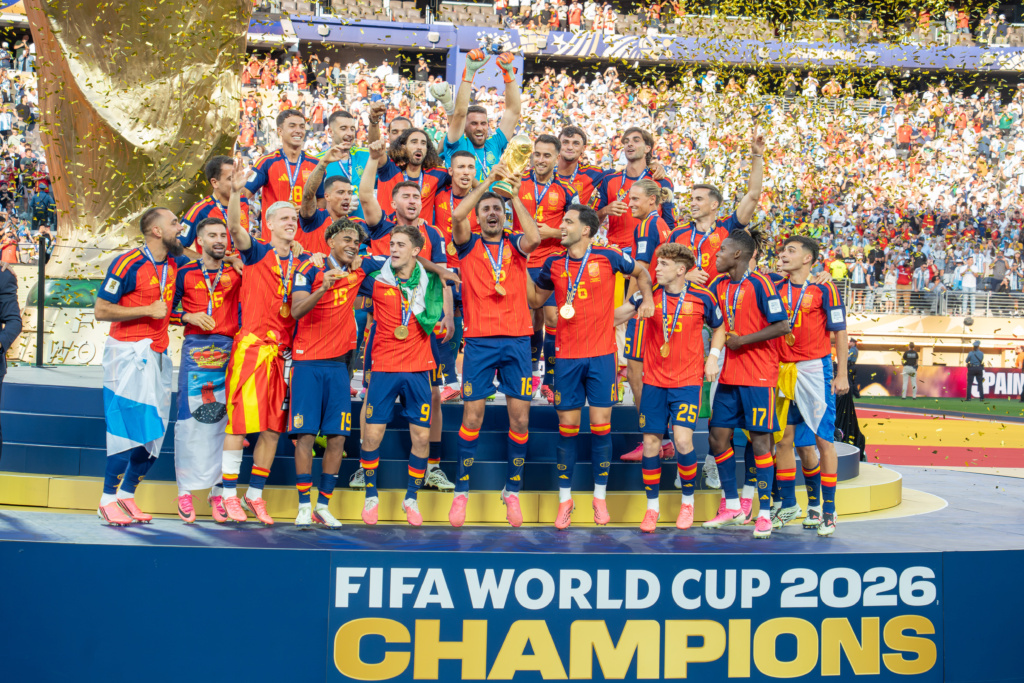
On the ground in Canada, Mexico and the United States, a record total of 6,810,966 fans packed into stadiums to watch the greatest show on earth. The atmosphere was vibrant and colourful across the 16 host cities, with supporters mixing freely and creating memories to last a lifetime. Thirty-nine days of thrilling action concluded on 19 July with a blockbuster final between Spain and Argentina. La Roja emerged triumphant, with Ferran Torres scoring an extra-time winner to deliver the nation’s second world title. Fitting champions for the biggest World Cup ever, Spain blended exceptional skill, poise and control with an unbreakable competitive spirit. They conceded just one goal throughout the tournament, while their slick attacking interchanges carved open opponents with surgical precision. Inspirational captain Rodri was the beating heart of their success, and the midfield colossus was recognised with the adidas Golden Ball Award.
Coach Luis de la Fuente, meanwhile, expertly shaped a collection of elite talents into a world champion side. “This team and this wonderful fanbase deserve everything,” he said in the aftermath of Spain’s triumph. “We had a date with destiny, and we wanted to make it count. It was written, and we deserved it.” Runners-up Argentina produced an admirable defence of the title they won in unforgettable fashion four years ago. Led by the evergreen Lionel Messi, they repeatedly dug deep to progress through the knockout phase, notably recovering from a two-goal deficit to beat Egypt in the last 16 and striking a stunning late double to overcome England in the semi-finals. It required a special team to dethrone La Albiceleste, and De la Fuente’s Spain were just that.
Superstars seize the stage
This was a World Cup where the sport’s biggest names came out to play. The irrepressible Messi may have turned 39 during the tournament, but he showed his mesmerising ability throughout Argentina’s run to the final, scoring eight goals and providing a further four assists.
France superstar Kylian Mbappe went home with the adidas Golden Boot award, with his ten strikes also seeing him become the competition’s all-time top scorer on 22 goals.
Powerhouse Norway striker Erling Haaland and all-action England talisman Jude Bellingham also lit up the biggest stage of all, each netting seven times to spearhead their nations’ campaigns. Haaland’s Manchester City team-mate Rodri, of course, was a dominant presence in Spain’s midfield. The great Cristiano Ronaldo, meanwhile, announced this would be his last World Cup following Portugal’s defeat to the would-be champions in the Round of 16. He left the bonanza having become the only man to score at six editions of the tournament. The 41-year-old followed up a clinical double in his team’s group-stage win over Uzbekistan with a penalty in their last-32 victory against Croatia.
Thrillers galore
The fans who flocked into World Cup stadiums and the millions more watching on television were treated to a succession of pulsating contests. Following a goal-laden and drama-filled group stage, the thrills continued in the knockouts. In the last 32, Belgium hit back from two goals down with less than five minutes left to beat Senegal, while Brazil, Portugal and Canada struck stoppage-time winners to see off Japan, Croatia and South Africa respectively. Cabo Verde pushed Argentina all the way to extra-time before being edged out 3-2, before La Albiceleste’s remarkable comeback to beat Egypt by the same scoreline in the next round.
England prevailed in a red-hot atmosphere to beat Mexico at Mexico City Stadium, and a Haaland masterclass saw Norway record a famous win over Brazil. The Three Lions, still stinging from their heartbreaking semi-final loss to Argentina, were then involved in the tournament’s highest-scoring game in the bronze final. Bukayo Saka was the star of the show, hitting a hat-trick in a 6-4 win against France.
Co-hosts make fans dream
Mexico, Canada and USA all progressed through the group stage and the opening knockout round to spark a wave of euphoria across their respective countries. Each of their campaigns featured memorable moments – from Mexico’s emotional victory over South Africa in the opening match, to Canada’s trouncing of Qatar, and USA’s thumping success against Paraguay. The co-hosts all bowed out at the last-16 stage, but not before inspiring generations of new fans and players with their memorable exploits on the greatest stage.
Emerging powers
World Cup 2026 highlighted the sky-rocketing standards of the game across the world. The expanded 48-team event gave more countries than ever the opportunity to showcase their talents – and the competition was notable for global heavyweights being repeatedly pushed to the limit by emerging football nations. Debutants Cabo Verde memorably showcased why they belonged on the global arena, going through the group stage unbeaten, with their results including a 0-0 draw with future champions Spain. The Blue Sharks were involved in a barnstorming last-32 tie with Argentina – and were one of nine African nations to advance to the knockout stage. Congo DR drew with Portugal on their way to reaching the Round of 32, where they gave England an almighty scare. Curaçao, the smallest nation ever to qualify, exited at the group stage but not before earning a memorable draw with Ecuador.
A World Cup of firsts
As well as being the maiden 48-team World Cup, this was also the first edition of the global finals to be held across three nations in Canada, Mexico and the United States. We had more matches than ever before, with 104 games across 39 days, and the inaugural Round of 32 knockout round at a World Cup. The last of those 104 fixtures, of course, was Spain and Argentina’s title showdown at New York New Jersey Stadium. A breathtaking spectacle, it featured the first-ever World Cup Final Halftime Show. Co-headliners Madonna, Justin Bieber, Shakira and BTS wowed fans with a series of awe-inspiring performances.
Medallists
Champions: Spain
Runners-up: Argentina
Third place: England
Award winners
adidas Golden Ball: Rodri (ESP)
adidas Silver Ball: Lionel Messi (ARG)
adidas Bronze Ball: Kylian Mbappe (FRA)
adidas Golden Boot: Kylian Mbappe (FRA)
adidas Golden Glove: Unai Simon (ESP)
FIFA Young Player Award: Pau Cubarsi (ESP)