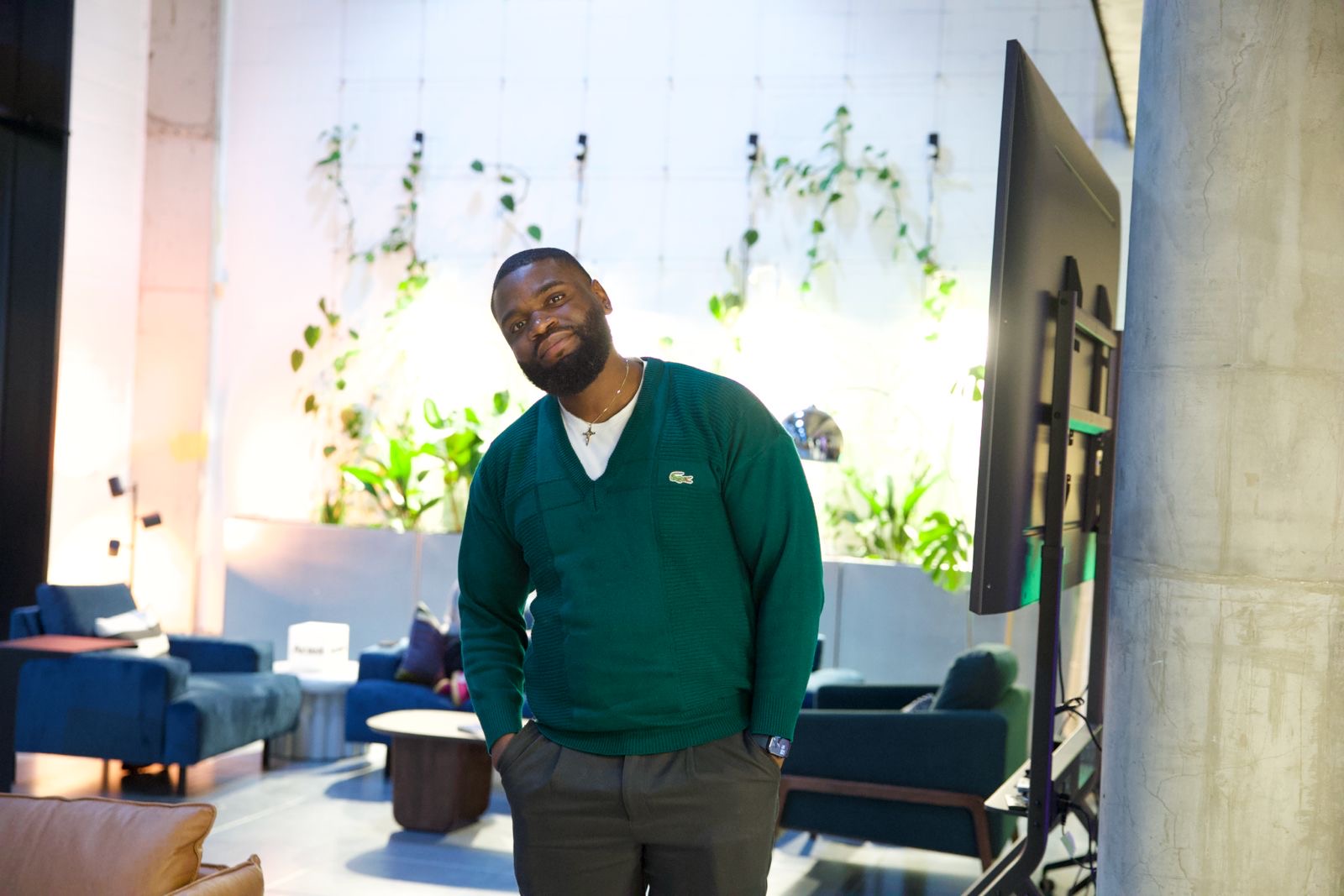
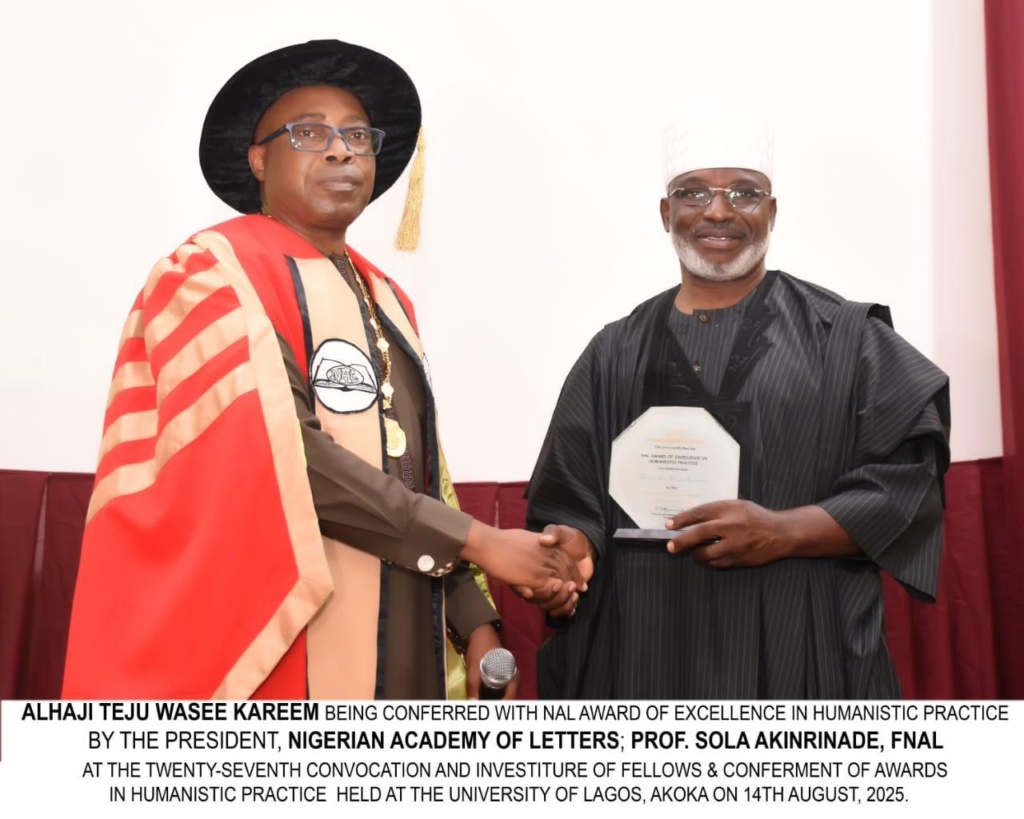
Olateju Wasee Kareem, a theatre design and technology expert, art entrepreneur, philanthropist, and founder/CEO of Zmirage Multimedia Limited has been celebrated for his visionary work in stage and lighting design, theatre production, and technical consultancy by the Nigerian Academy of Letters (NAL).
Who is Teju Kareem and who is Zmirage?
Teju Kareem is a distinguished theatre design and technology expert, a producer, and an entrepreneur. I trained in scenography and lighting at the University of Ibadan, later earning a postgraduate diploma in business administration from the UK. I am tested in theatre, bold in business, generous in giving.
Zmirage is the pioneering technical theatre company I founded in 1996 to fill the infrastructural gap in Nigeria’s entertainment industry.
Can you talk to us on your early days, we mean your experience at UI and how you transpose to the National Theatre?. The revolve stage, the Ben Bruces’s MBGN etc.
My journey began at the University of Ibadan, where I immersed myself in the world of scenography and lighting. Those were formative years, hours spent experimenting, learning, and discovering the magic of transforming empty spaces into living stories. After UI, I moved on to the National Theatre, a place that felt like stepping into the beating heart of Nigerian performance culture.
I still remember the thrill of working with the revolve stage, watching a set transform before the audience’s eyes was pure theatre magic. Then came opportunities to work on major productions and events, like Ben Bruce’s Most Beautiful Girl in Nigeria pageant, where I learned to blend creativity with precision under high-pressure conditions. Those experiences didn’t just sharpen my technical skills, they taught me how to dream big and execute at a world-class level.
Teju Kareem had three phases of transitions so far. (A) his early days in the University of Ibadan. (B) his immediate post-graduation days in Lagos and ultimate relocation to the UK. (C) his return in 1997 with new automated entertainment technology systems that revolutionize the Theatre world”. Kindly comment on the above.
Yes, I’d say that sums it up quite well, three very distinct, but connected phases.
Phase one was my time at the University of Ibadan, which gave me the foundation not just in theatre arts, but in discipline, creativity, and understanding how every element of a production works. That period shaped my respect for both artistry and technical precision.
Phase two began right after graduation, when I moved to Lagos and immersed myself in the professional scene, eventually relocating to the UK. Those years opened my eyes to international standards, new ways of thinking, and the importance of marrying creativity with efficiency. I was like a sponge, absorbing knowledge, skills, and exposure from some of the best in the business.
Phase three came with my return to Nigeria in 1997, armed with new automated entertainment technology systems that were barely in use here at the time. Introducing those tools from computerised lighting to advanced stage mechanics was a game-changer. They didn’t just make productions sleeker; they expanded the possibilities for storytelling on stage in Nigeria.
So yes, those three transitions were not just career stages, they were building blocks, each preparing me for the next, and together they’ve shaped the way I approach cultural production today.
Would you say that the Nigerian Scenographic space has come of age?
I would say the Nigerian scenographic space has grown tremendously, but “come of age” depends on how we define it. In terms of creativity, there’s no question. Nigerian designers are innovative, resourceful, and capable of producing world-class work, often under challenging conditions. We’ve moved from makeshift setups to more deliberate, concept-driven stage designs that respect both the artistic vision and the audience’s experience.
However, in terms of infrastructure and investment, we still have some ground to cover. True scenographic maturity requires not just talent, but also access to modern tools, continuous training, and venues that are technically equipped to support complex designs.
What excites me is that the younger generation of Nigerian theatre and event designers are thinking globally but working locally, adapting modern techniques to our own cultural contexts. So, while we’re not at the final destination, we’re definitely on the expressway and the journey ahead looks promising.
What do you think really militates against the attainment of a full revolution in theatre design and Technology in the Nigerian theatre?
I think there are a few key factors holding us back from a full revolution in theatre design and technology in Nigeria.
First is infrastructure. Many of our performance venues are outdated, lacking the basic technical facilities needed for modern scenography. Without the right equipment, lighting grids, rigging systems, automated staging, even the most brilliant designer is limited.
Second is investment. Theatre technology is not cheap. It requires consistent funding, not just for purchase but for maintenance and upgrades. Too often, budgets prioritise the visible glamour of a production but overlook the behind-the-scenes technology that truly elevates it.
Third is training and knowledge transfer. We have incredibly talented practitioners, but many learn through improvisation because there aren’t enough structured opportunities for professional development in advanced stagecraft. In other countries, designers and technicians regularly train on the latest systems; here, we often have to self-teach and adapt.
Finally, there’s policy and cultural prioritisation. Until arts and culture are seen as vital sectors worthy of strategic government and private sector investment, theatre technology will remain underdeveloped.
If we address these four areas infrastructure, investment, training, and policy, I believe we can spark not just evolution, but a real revolution in Nigerian theatre design and technology.
In your years of practice as a scenographer, what productions have given you the most challenges and how did you overcome them?
Over the years, I’ve worked on productions that tested not just my technical skills, but my creativity, patience, and problem-solving abilities. One that stands out is Kongi’s Harvest at the National Theatre. The vision was grand, but the facilities at the time were far from what we needed. We had to literally re-engineer the stage mechanics to make the director’s ideas possible building custom rigs, reprogramming lighting, and working overnight to make scene changes seamless. It was exhausting, but the applause on opening night made every drop of sweat worth it.
Another was staging The Lion and the Jewel in an open-air venue during the rainy season. Every scenographer’s nightmare is water meeting electronics. We designed a weather-proof rigging and lighting system, built quick-drain flooring, and had a rapid-cover system in place. The audience never knew how close we came to disaster and that’s the magic of good stagecraft.
Then there’s international touring productions, where the challenge is adaptability. Moving a show from Lagos to London or New York means redesigning the set to fit new stage dimensions, different regulations, and sometimes completely different technical infrastructures. You learn to think like an engineer, an artist, and a diplomat all at once.
What I’ve learned is that challenges are inevitable in scenography but they’re also opportunities. Each obstacle forces you to innovate, I had to lean on teamwork, meticulous planning, and the ability to adapt in real time. In technical theatre, you learn quickly that even the best-laid plans can shift in an instant, so you stay calm, think on your feet, and trust your instinct and your crew. Those moments of pressure have been my greatest classrooms and those innovations became part of my signature style.
What productions/performances would you say is your best in terms of creativity?
That’s a tough one, because each production has its own unique creative heartbeat. But if I had to choose, a few stand out.
One is The Beatification of Area Boy by Wole Soyinka. The script itself is rich with texture, and it gave me the chance to merge realism with symbolic set pieces creating a space that felt both familiar and theatrical, allowing the audience to step into Soyinka’s layered world.
Another is the Wole Soyinka International Cultural Exchange (WSICE) performances, especially the youth-inspired segments. Here, creativity isn’t just in the set or lighting, but in crafting a visual language that inspires and speaks directly to younger audiences while staying rooted in African aesthetics.
And then there are some of the large-scale international collaborations we’ve done — productions where African storytelling met cutting-edge stage technology. Those moments, where tradition and innovation dance together, are the ones I’m most proud of.
For me, the “best” isn’t about spectacle alone it’s when design, story, and technology align so perfectly that the audience forgets they’re watching a performance and instead feels they’re living inside the story.
How would you rate the training of Nigerian theatre designers in our higher institutions?
I would say Nigerian higher institutions have laid a solid foundation for theatre design training, especially in the theoretical and creative aspects. Our universities and polytechnics produce graduates who understand the principles of scenography, costume, lighting, and set construction.
However, the real gap is in practical exposure. Many of our training facilities are outdated, and students rarely get hands-on experience with the kind of modern equipment and technology used in today’s global theatre industry. So, while their ideas are strong, their transition into professional practice often requires a steep learning curve.
Another issue is the disconnect between academia and industry. In many countries, students work directly on professional productions during their studies. Here, that link is weaker, so graduates often have to re-learn certain processes once they enter the field.
That said, I’m encouraged by the resilience and adaptability of Nigerian theatre designers. Even with limited resources, they innovate. If our institutions invest more in up-to-date equipment, industry partnerships, and continuous faculty training, we’ll not just catch up, we’ll set new global benchmarks.
If we can bridge the gap between theory and real-world practice, Nigeria will not only train exceptional designers, we’ll lead the conversation in African technical theatre.
Can you comment on the theatre and other forms of entertainment in Nigeria from the technology perspective?
We’ve come a long way; Nigerian theatre and entertainment now use far more advanced lighting, sound, and stage technology than when I started. Yes, challenges like power and equipment costs remain, but our creatives have mastered the art of making magic with what’s available. With more investment in people and tools, the future looks even brighter.
What advise would you give to would be Nigerian Scenographers?
I’d say: Pair your creative vision with business acumen, strive for technical excellence, be fair and client-focused, and build sustainable practices, turn your passion into both art and a profession. Build a strong foundation. Learn the principles of design lighting, set construction, space, texture, and how all these elements work together to serve the story. Don’t just focus on the artistic side; understand the technical side too. A great design on paper is meaningless if it can’t be built or operated efficiently.
Never stop learning. Theatre technology evolves quickly, so expose yourself to global best practices. Attend workshops, follow international trends, and study how different cultures approach scenography. Even if you can’t always access the latest tools, knowing how they work will help you innovate with what you have.
Also, collaboration is key. Scenography is not a solo art, it’s about working seamlessly with directors, actors, costume designers, and technicians. The best scenographers are not just artists; they are problem-solvers and team players.
There has been, in recent times, a call/cry in some quarters that there is gender imbalance in the design aspect especially scenic and lightning areas of theatre: what is your take on it?
Yes, that observation is valid globally, and in Nigeria, there’s been a historical gender imbalance in the more technical aspects of theatre, such as scenic and lighting design. Traditionally, these areas were seen as “heavy” or “technical” work, and cultural stereotypes often discouraged women from entering them.
However, I’ve also seen a positive shift in recent years. More young women are training and excelling in stagecraft, lighting operation, projection mapping, and set construction. Some of the most innovative designs I’ve encountered in workshops and productions have come from female designers who bring fresh perspectives and attention to detail.
The key now is to create more entry points, mentorship programmes, targeted scholarships, and inclusive training environments, so that women feel encouraged and supported to enter and thrive in these areas. Representation matters; when young women see others like them succeeding behind the console or leading a set build, it breaks the myth that these roles are “for men.”
My take is simple: talent has no gender. What matters is skill, creativity, and professionalism. If the industry actively fosters inclusivity, we will not only correct the imbalance but also enrich Nigerian theatre with a wider range of voices and visions.
For Teju Kareem what is in the offing?
For me, the journey is far from over in fact, I feel like I’m just entering another exciting chapter.
On the other hand, Zmirage Multimedia Limited is pushing into more ambitious projects from large-scale touring productions to partnerships that will bring state-of-the-art stage technology and training to Nigeria. I’m passionate about building a pipeline for young scenographers, lighting designers, and stage technicians to gain hands-on experience with world-class tools.
On one hand, I’m focused on expanding the reach and impact of the Wole Soyinka International Cultural Exchange (WSICE), making it an even stronger platform for youth engagement, cultural dialogue, and international collaboration. We’re looking at new ways to integrate technology, digital storytelling, and virtual participation so our reach goes far beyond physical venues.
There are also plans in motion for international co-productions that will showcase African stories on global stages, combining traditional narratives with cutting-edge scenographic innovation.
So, what’s in the offing? More bold projects, more collaborations, and more platforms where creativity meets excellence because for me, the work is not just about producing shows, it’s about shaping the future of performance in Africa while I can’t reveal everything just yet, you can be sure there are exciting ideas and partnerships ahead.
How do you see the Nigerian Scenic graphic space in the next decade?
In the next decade, I see the Nigerian scenographic space moving from adaptation to innovation. Right now, we’re brilliant at taking global ideas and tailoring them to our realities. In ten years, I believe we’ll be exporting our own uniquely African design concepts and stage technologies to the rest of the world.
We’ll see better-equipped theatres both purpose-built venues and upgraded existing spaces, giving designers more freedom to experiment. Technology like automated rigging, projection mapping, and immersive set design will become more accessible, not just for big productions in Lagos and Abuja, but across the country.
I also expect a new generation of scenographers, men and women trained both locally and internationally, who will combine technical mastery with a deep understanding of African aesthetics. That blend will give Nigerian theatre a distinct global signature.
Most importantly, I see stronger industry, academia partnerships, ensuring students graduate with hands-on experience using the latest tools. With consistent investment, policy support, and a culture that values stage design as much as performance, the next decade could mark Nigeria’s full emergence as a leader in creative stagecraft.
In short, the future is bright, and the stage is set.
You were honoured by SONTA in 2013, please, what is your word to SONTA as an Organization, And How do you think that SONTA could help in moving theatre practice forward, especially as it concerns Theatre design and technology?
I am deeply grateful to SONTA for the honour bestowed upon me in 2013. It remains a treasured recognition, not only of my personal contributions, but also of the shared spirit that drives our creative community. SONTA has been and continues to be, a vital platform for nurturing talent, safeguarding our cultural heritage, and promoting excellence in theatre and the performing arts.
I am pleased to see SONTA constantly evolving. For example, at this year’s LASU conference, I learned that a panel on Theatre Design and Technology has been initiated by Alphonsus Orisaremi and Dr. Grace Adinku, with a commendable response to the call for papers. This is an encouraging step, and I believe it can be further strengthened by incorporating workshops and training sessions, an area I would be glad to support.
In addition, SONTA should consider expanding its scope to include curated professional performances, followed by critical post-mortem discussions to deepen learning and engagement. Furthermore, the organization could institute an annual, well-researched “State of the Arts of the Theatre” report. Such a document, if thoughtfully prepared, could influence policies and shape national conversations on the future of the performing arts in Nigeria.
My word to SONTA is this: remain steadfast in your mission, continue to uphold the highest standards of professionalism, and keep creating opportunities for both established and emerging artists to thrive. The future of our art form depends on such dedication. May SONTA grow from strength to strength.