By Olakunle Agboola – Recent protests in parts of South Africa have once again exposed a recurring national tension, one rooted in economic hardship, migration, and public perception.
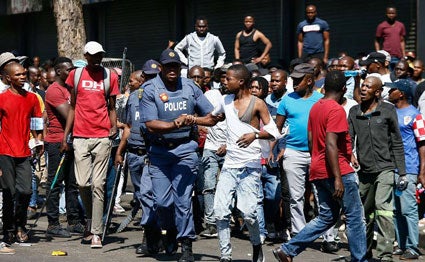
What began as organised demonstrations under the “march to march” movement escalated into violence, with foreign nationals, particularly Black African migrants, targeted through looting, assault, and intimidation. The scenes are familiar.
South Africa has witnessed similar outbreaks in 2008, 2015, and 2019, each marked by the same underlying pattern. Economic frustration is redirected toward foreign nationals, even when the evidence does not support the claims. A Small Population, A Disproportionate Blame The dominant claim among protesters is that foreign nationals are taking jobs and driving crime. However, available data challenge this narrative.
According to Statistics South Africa, the country’s population was estimated at 62 million in its 2023 mid-year report, with foreign nationals accounting for approximately 3.6 per cent. This brings the migrant population to just over 2.2 million. At the same time, the official unemployment rate stood at 32.9 per cent in the first quarter of 2024, with youth unemployment exceeding 59 per cent. The imbalance is stark. A relatively small migrant population is being blamed for a structural labour market crisis affecting millions. As Haroon Bhorat, Professor of Economics at the University of Cape Town, noted in a 2022 labour market analysis, South Africa’s unemployment crisis is structural in nature and cannot be explained by migration flows.
The labour market has been unable to absorb new entrants for decades, and the problem is rooted in low growth, skills mismatches, and long-standing inequalities. Economic research consistently shows that migrants tend to cluster in sectors where South Africans are either underrepresented or unwilling to work. These include informal retail, domestic work, hospitality, and small-scale manufacturing.
Migrants often create microenterprises that employ South Africans, particularly in township economies. The idea that a population representing less than four per cent of the country is responsible for mass unemployment does not withstand scrutiny.
Crime, Perception, and Evidence Crime remains a central concern, driving public anger. Protest rhetoric frequently links foreign nationals, particularly Nigerians, to drug trafficking and organised crime. However, official figures from the South African Police Service do not support broad generalisations about nationality. While South Africa continues to battle high crime rates, police data does not identify foreign nationals as the primary drivers.
Further insight comes from correctional services data. A 2023 report by the Department of Correctional Services indicated that over 90 per cent of the prison population are South African citizens, with foreign nationals making up a small minority.
This does not mean that no foreign nationals commit crimes. It means that the scale of criminality attributed to them is exaggerated and often shaped by perception rather than evidence. As criminologist Guy Lamb observed in a 2021 policy discussion, linking crime trends to nationality oversimplifies a complex problem driven largely by inequality, social conditions, and systemic policing challenges.
Crime in South Africa is deeply rooted in historical deprivation, weak law enforcement capacity, and the social consequences of exclusion. Nationality is not the primary factor.
Voices from the Ground Despite the data, public perception tells a different story. A retail worker in Durban, who requested anonymity, described the frustration. South Africans are struggling to find jobs, and the visibility of migrant owned shops creates a sense of competition.
The worker explained that people see foreign-owned businesses doing well and feel anger, even when they do not understand the broader economic forces at play. For migrants, the experience is marked by fear and instability. A Nigerian shop owner in Michael described the anxiety that accompanies every protest. Migrants come to South Africa to work and survive, but when unrest begins, they are often the first targets. Many lose businesses, stock, and sometimes everything they have built over the years.
These accounts highlight a deeper tension. The issue is not only economic. It is emotional and deeply personal. It reflects a society grappling with scarcity, inequality, and a sense of abandonment.
The Structural Reality: Inequality and Limited Opportunity South Africa remains one of the most unequal countries in the world, with a Gini coefficient consistently above 0.60. Despite the end of apartheid, disparities in wealth, land ownership, and access to opportunity persist. The democratic transition led by Nelson Mandela prioritised political reconciliation and national unity. This approach was critical in preventing widespread conflict at the time. However, the structural transformation of the economy has been slower and more uneven.
Policies such as Black Economic Empowerment were introduced to address historical inequalities. While they have created a growing Black middle class, critics argue that benefits have been unevenly distributed, leaving many communities still excluded from meaningful economic participation. In such an environment, visible competition at the lower end of the economy, particularly in informal trade and small business sectors, intensifies resentment toward foreign nationals.
Economic analysis shows that South Africa’s growth has been too slow to absorb new labour market entrants. The economy has expanded at an average of less than two per cent over the past decade. This is far below the level required to reduce unemployment. When growth is weak and opportunity is scarce, competition becomes sharper, and migrants become convenient scapegoats.
Distrust, Governance, and the Rise of Vigilantism Recent protests have also revealed a troubling erosion of trust in state institutions. Reports of civilians demanding identification documents, influencing hiring practices, and attempting to restrict access to public services signal a shift toward informal enforcement.
President Cyril Ramaphosa has condemned these actions, emphasising that immigration enforcement must remain within the authority of the state. However, many citizens perceive law enforcement responses as slow or inconsistent, particularly regarding undocumented migration and localised crime. This perception has created space for vigilantism, a development that risks undermining constitutional order and deepening social divisions. When communities feel that the state is absent, they begin to police borders, streets, and workplaces themselves. This is a dangerous trajectory. It normalises violence and erodes the rule of law.
Recurring Cycles, Unresolved Pressures Migration into South Africa, particularly from countries such as Zimbabwe, Nigeria, and Somalia, is largely driven by economic necessity. As one of the continent’s most industrialised economies, South Africa continues to attract individuals seeking better opportunities. However, without inclusive economic growth and effective urban policy, competition in already strained communities becomes inevitable. The recurrence of xenophobic violence suggests that these pressures remain unresolved. Each cycle reinforces mistrust, damages livelihoods, and weakens social cohesion. The country cannot continue to treat each outbreak as an isolated incident. It is a symptom of deeper structural failures.
Toward Practical Solutions Breaking this cycle requires targeted and realistic interventions. Labour market reform must address both unemployment and informality. Expanding support for township economies, improving access to finance for small businesses, and formalising parts of the informal sector can reduce zero-sum competition. Immigration systems need to be more efficient and transparent. Faster processing of documentation and clearer enforcement protocols would reduce uncertainty and limit opportunities for exploitation and misinformation.
Data-driven public communication is essential. Government and media institutions must actively counter false narratives with accessible and verifiable information. Community-level integration initiatives should be prioritised. Structured dialogue between residents and migrant communities can reduce tension, build trust, and shift perceptions from competition to coexistence.
Way Forward The latest wave of xenophobic violence in South Africa reflects deeper structural challenges, not simply the presence of foreign nationals. A migrant population representing less than four per cent of the country cannot reasonably account for systemic unemployment and crime.
What is unfolding is a crisis of inequality, perception, and governance. Until these underlying issues are addressed with clarity and commitment, the cycle of blame and violence is likely to continue, with consequences that extend far beyond the communities directly affected.