
By Iyamide Thomas – It’s that time of the year again – 14 February, also known as Saint Valentine’s Day! The day – it is said – is named after a saint called Valentinus who was imprisoned for performing weddings on soldiers forbidden to marry, and for ministering to Christians who were persecuted under the Roman Empire. Legend has it that he healed the daughter of his jailer and before his execution he wrote “from your Valentine” as a farewell to her!
Saint Valentine Day is now associated with romance and an occasion when lovers (current or would-be!) express their love with flowers, chocolates, romantic gestures and ‘Valentine’s Day’ cards, some unsigned – indicating to the recipient that they have an anonymous admirer somewhere!
Do You Know Your ‘Type’?
As many new liaisons are formed on or just after Valentine’s Day, my article heading advises you to ‘know your type’. There are two ‘types’: the type of people you might be attracted to this Valentine’s Day and your haemoglobin genotype (see what I did there?). Your haemoglobin genotype tells you the two genes (i.e. codes) – one inherited from each parent – that determine your type of haemoglobin. Haemoglobin is the substance in your blood that gives blood its red colour and carries oxygen around your body. The type of haemoglobin genes you inherit or pass on can play an important role in determining whether you or your children are affected by two serious inherited blood conditions – sickle cell disease and thalassaemia.
Sickle cell disease can cause severe pain, anaemia and organ damage. It mainly affects people who originate from Africa, the Caribbean, Asia, the Middle East and the Mediterranean. However, it can affect ‘White’ people too, though less frequently. Out of the 15 million people estimated to have sickle cell worldwide, around 10 million live in Africa of which approximately 4 million are in Nigeria. In the UK it is now estimated that 18,500 people have sickle cell disease and each year around 300 new babies are born with the condition.
Thalassaemia is a condition most common among people originating from India, Pakistan, Bangladesh, Cyprus and China. People can inherit Beta Thalassaemia major which affects their ability to produce enough red blood cells. This causes severe anaemia and organ damage and they need to be on regular blood transfusions throughout life. In the UK, approximately 2770 people are living with thalassaemia and around 30 babies are born with it each year.
The most common genotype combination is HbAA which involves two usual haemoglobin genes. Other genotype examples are HbSS (sickle cell anaemia), HbSC (Sickle Haemoglobin C disease) and HbSβthal (Sickle beta-thalassaemia), indicating that unusual genes have been inherited for making haemoglobin, resulting in the three most common types of sickle cell disease. If you have one usual and one unusual gene combination such as HbAS, you are known as a sickle cell ‘carrier’ or ‘trait’. You do not have sickle cell but can pass on the gene to your unborn child.
Finding Your ‘Type’
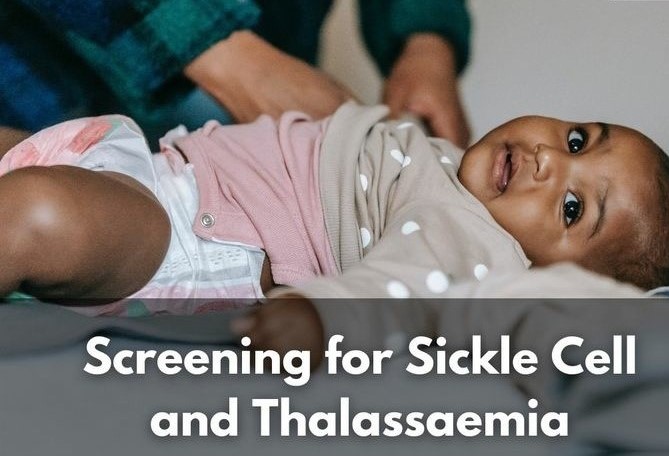
In the United Kingdom, there is an NHS Sickle Cell and Thalassaema (antenatal and newborn) Screening Programme which offers all pregnant women a screening blood test which is then offered to the father-to-be if the woman is found to be a carrier. Each time two ‘carriers’ have a baby there is a 25% chance the baby could be born with sickle cell disease (this is the same for thalassaemia). The Programme also screens newborn babies for sickle cell. Before pregnancy or planning a baby, you can ask your GP for the screening blood test, particularly if you know of close family members who have sickle cell or thalassaemia or are carriers. This is known as preconception testing. In some parts of the country there are NHS Sickle Cell and Thalassaemia centres that will also do preconception testing if you live in their catchment area. These centres can be found here: https://www.sicklecellsociety.org/supportgroups/
New Screening Podcast for Valentine 2026!
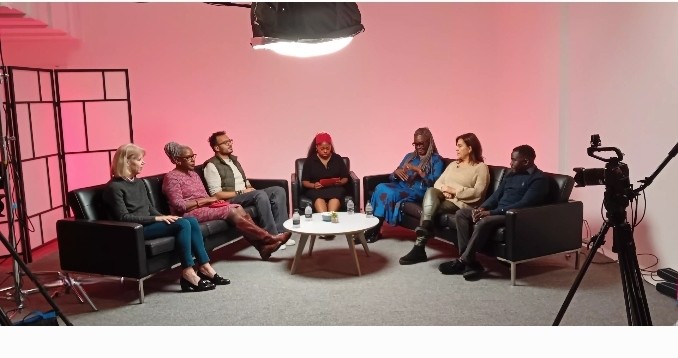
Sickle Cell Society podcast panelists which include guests from UK Thalassaemia Society, NHS health professionals, service users and our host
Just in time for Valentine’s Day, the Sickle Cell Society has launched a new podcast episode entitled ‘Pregnancy Planning and NHS Screening for Sickle Cell and Thalassaemia’. The video and audio podcast editions are available at these links:
The podcast was producedin conjunction with the NHS Sickle Cell and Thalassaemia Screening Programme and the UK Thalassaemia Society with which they do joint work. Targeted particularly at younger people who have not yet had children (i.e. ’preconception’), the podcast brings together a specialist nurse, screening experts and people with lived experience of sickle cell and thalassaemia to discuss everything about screening and testing such as:
- How and when screening happens across the UK’s NHS — including newborn, antenatal and adult testing
- Why knowing your genotype or carrier status early can make a critical difference towards informed choice
- Barriers to accessing testing, particularly in areas of low prevalence
- Inequalities in screening, GP awareness, and regional services
- The emotional and cultural stigma that still surrounds genetic testing
- Why fewer men than women are taking up preconception testing
In addition to the podcast, the Societies are in the process of producing a ‘preconception screening leaflet’- particularly for individuals of child-bearing age who have not yet had children, so watch this space.
Post Valentine, be the perfect partner!
Once the valentine cards, chocolates and flowers are over, why not learn more about sickle cell and thalassaemia so you can make informed choices (about testing) if and when the need arises? By so doing, you just might be considered that perfect partner after all!
Below are websites with lots of information to help you:
Sickle Cell Society
Email: info@sicklecellsociety.org
UK Thalassaemia Society
Email: office@ukts.org
Iyamide Thomas is the NHS Engagement Lead (Screening Programme), Sickle Cell Society UK