
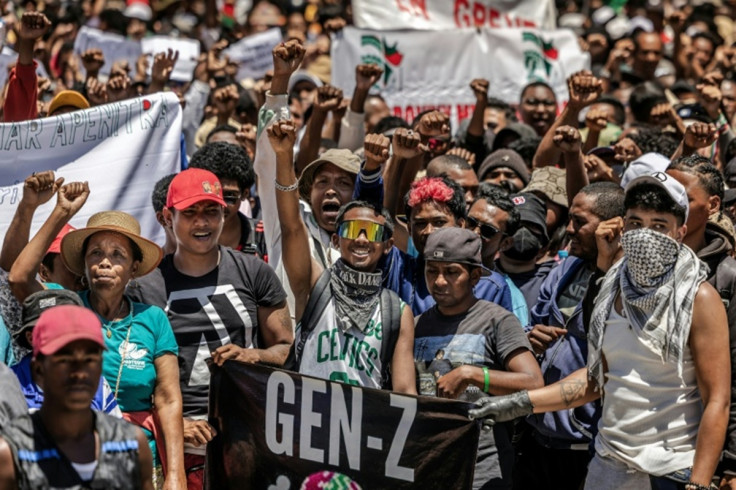
By Olakunle Agboola – Madagascar’s October 2025 uprising is not just another political revolt. It is a statement, a loud one. It represents a generation of Africans who are done with colonial leftovers and political puppetry disguised as democracy.
The fall of President Andry Rajoelina may seem like a local event, but it is part of a larger continental awakening. From Mali to Niger, from Burkina Faso to Madagascar, Africa’s youth are taking back control of their nations. The message is clear: Paris will no longer hold the pen that writes Africa’s story.
The Spark That Ignited the Streets
It began with blackouts and water shortages in Antananarivo. Daily frustrations turned into defiance. Citizens who initially demanded electricity soon demanded freedom.
The phrase “We want light” took on a double meaning. It was about electricity, but also about enlightenment, empowerment, and the desire to see the truth.
According to World Bank data, over 70 percent of Madagascar’s population faces electricity shortages, and inflation rose above 11 percent in 2024. The economic pressure became unbearable for ordinary citizens who already struggle with one of the world’s lowest GDP per capita rates which is about $540.
The Soldiers Who Chose the People
The turning point came when Madagascar’s elite military unit, CAPSAT, refused to fire on civilians. They joined the protesters instead. Within hours, the government’s authority disintegrated.
Ironically, this was the same unit that had helped Rajoelina seize power in 2009. By October 13, 2025, the president’s rule had collapsed, and that night he fled aboard a French military aircraft.
To the Malagasy people, that image was symbolic, a leader running for safety under France’s wings confirmed that colonial ties still dictated who held power and who didn’t.
France’s Shadow Over Madagascar
France’s influence in Madagascar and across Africa has long been wrapped in diplomatic language. Yet beneath that polite façade lies a web of economic control.
Nearly 75 percent of Madagascar’s export contracts remain linked to French companies, especially in nickel, cobalt, and vanilla resources that should have been the backbone of national prosperity. France remains Madagascar’s top trading partner, accounting for roughly 30 percent of foreign investment inflows.
This economic dependency is mirrored across Francophone Africa, where the CFA franc still ties national economies to the French Treasury. The question many Africans now ask is simple: when will we truly own our destiny?
The Sahel Effect and the Spirit of Defiance
The Sahel region has become the epicenter of African resistance. Mali, Niger, and Burkina Faso have expelled French troops and formed the Alliance of Sahel States to build regional autonomy.
Madagascar may not be part of this alliance, but its uprising carries the same pulse. It is not about hostility toward France; it is about dignity, pride, and sovereignty.
Africans are no longer asking for freedom. They are claiming it.
The Digital Generation That Refuses to Wait
This revolution was not sparked in military barracks but on smartphones. Madagascar’s youth (Gen Z) organized online, using encrypted apps and social media to coordinate protests.
They no longer trust traditional political parties or foreign NGOs. They trust each other. This is Africa’s digital generation; young, connected, and fearless. They may not remember colonial rule, but they live daily with its consequences.
Across the continent, more than 70 percent of Africa’s population is under 30. That demographic reality alone is reshaping politics. Young people are not waiting for reform; they are creating it.
Turning Away From France, But Not Into New Chains
As Africa turns away from France, new players are moving in. China, Russia, and Turkey are offering trade, arms, and technology deals. But Africa must be careful not to swap one master for another.
Replacing Western control with Eastern dependence is not liberation. It is rotation. True independence lies in regional cooperation, African-owned trade routes, and transparent governance.
The next revolution Africa needs is one of governance; not just removing leaders but building systems that make corruption impossible.
The Risk and the Responsibility
Military takeovers often begin as people’s victories but can quickly become power traps. History shows that soldiers who promise reform sometimes to become the rulers they once opposed. Mali’s ongoing struggle to return to civilian rule is a warning.
Madagascar’s new leadership must prove this uprising is different. The victory should not end on the streets but continue through a constitution that empowers citizens, limits the military’s reach, and guarantees accountability.
Foreign powers should resist the temptation to “restore order.” Africa does not need supervision. It needs space to rebuild itself.
A Continent Rewriting Its Script
Across Africa, a new truth is emerging. The continent is not descending into chaos; it is shaking off control. The Sahel’s defiance and Madagascar’s rebellion are not symptoms of instability; they are signs of self-determination.
The colonial hangover is fading. The process is painful but necessary. The future will be messy but authentic. Real transformation always is.
The next chapter of Africa’s story will not be written in Paris, Washington, or Beijing. It will be crafted in the streets of Antananarivo, Bamako, and Ouagadougou by Africans who believe in their right to shape their own destiny.
Madagascar’s uprising is not just about a fallen president. It is a symbol of a continent reclaiming its identity. It is a declaration that the days of submission are over.
Africa is not broken. It is being reborn. And this new generation is done asking for permission to be free.
Kindly follow us on twitter:@AfricanVoice2